
The Council of Six
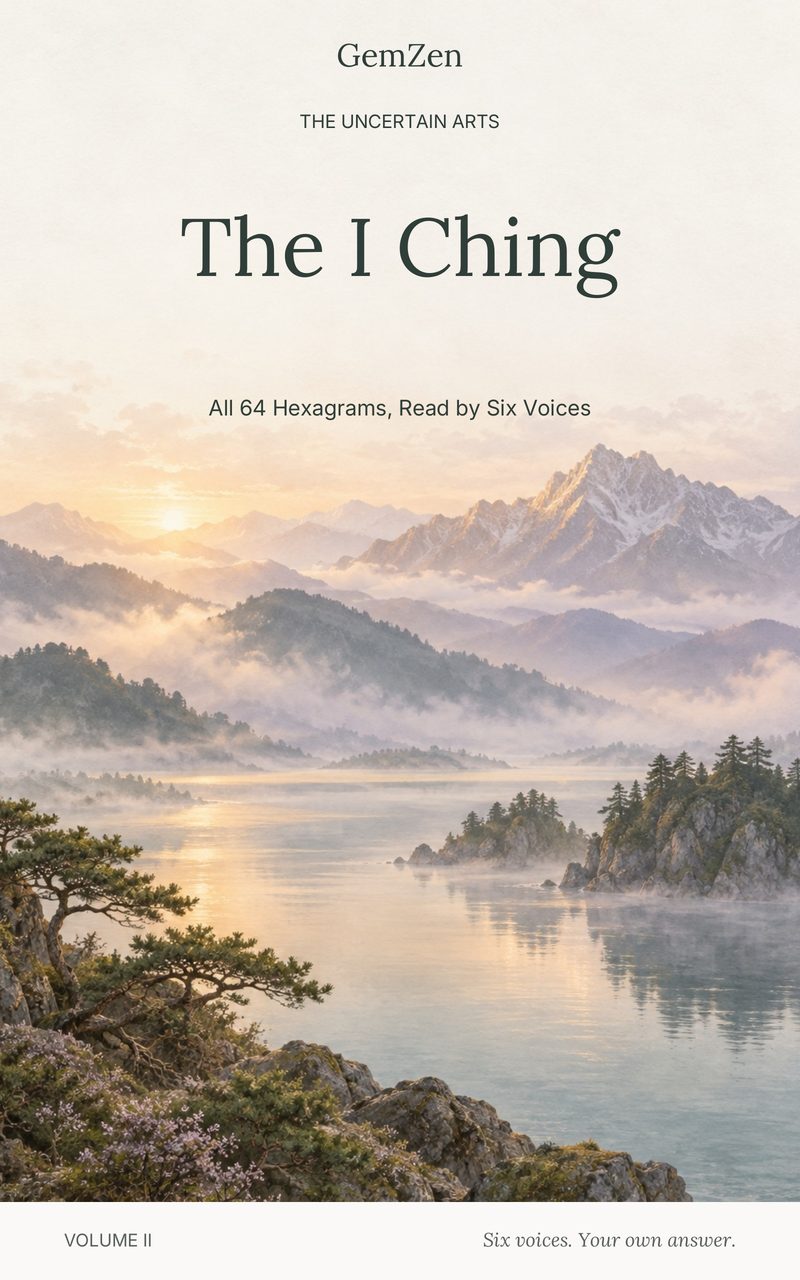
Jacket of The I Ching, volume 2 of The Council of Six

Volume 2 of 23

The I Ching

All 64 Hexagrams, Read by Six Voices

Every one of the 64 hexagrams in this book is read six times, by six voices who do not agree, and the disagreement is more useful than any single reading.

Evidence
Traditional
Attested
c.800 BCE — the Zhouyi core text, Western Zhou
Contents
64 hexagrams, read six times each
Extent
285 pages, 6 x 9 inches
Planned editions
Paperback and ebook editions are planned. No ISBNs have been issued; audiobook recordings are not available.
ISBN
Not yet issued

$8.99

Paperback is planned. The displayed price and delivery ladder are unverified proposals; orders are not open — see the ladder.

1

Or take all 23 volumes at a proposed set price; audiobook recordings are not available.

What this book is

The I Ching is three thousand years old and still the best-designed question-asking machine ever built.

This edition gives you all sixty-four hexagrams — judgment, image, interpretation, advice, and every changing line — and then does something no classical translation does: it hands each hexagram to six different readers.

The Astrologer reads its timing. The Body Reader asks where it sits in you. The Herbalist asks what it costs. The Strategist wants the next move. The Skeptic asks whether you are reading the situation or your own hopes. The Mystic reads it as the Book of Changes was meant to be read.

Includes a plain-English guide to casting with coins, how to read a changing line without getting lost, and what to do when the answer is not the one you wanted.

Where this comes from

Earliest surviving evidence

A Western Zhou ritual hall at night with bronze vessels, yarrow stalks and a scorched turtle shell.

The Zhou Yi, the core text of hexagram and line statements

The Zhou royal domain, north China · Old Chinese · 800 BCE

Sixty-four hexagrams, each with a short judgement and six line statements. The language is terse, concrete and often agricultural or military — captured oxen, a wounded thigh, crossing a great water. There is almost no philosophy in it. It is a diviner's field manual, and it reads like one.

How it reached you

  1. 800 BCE

    Zhou court diviners

    Edward Shaughnessy dates the compilation in roughly its present form to the last quarter of the ninth century BCE; other scholars place the assembly anywhere from the tenth to the fourth century. Before it, the same questions were put to heated turtle plastrons.

  2. 350 BCE

    The Confucian school, over roughly two and a half centuries

    The Ten Wings are appended — commentaries that turn an oracle into a cosmology. Tradition credits Confucius; linguistic analysis and the Mawangdui silk manuscripts recovered in 1973 show a school rather than a man, writing between roughly 350 and 100 BCE.

  3. 1882

    James Legge

    First major English translation, from a philological and missionary standpoint.

  4. 1924

    Richard Wilhelm, German; Cary Baynes, English, 1950

    The translation that made the book a Western object. Wilhelm worked with the scholar Lao Naixuan and rendered the text through a deliberately elevated register; Jung's foreword to the English edition supplied the psychological reading almost every modern Western user has inherited.

The version you have actually met

1950 · Wilhelm, Baynes and Jung

The book Western readers consult is a 1950 English translation of a 1924 German translation, framed by a Jungian foreword about synchronicity that has no counterpart in any Chinese edition.

What you have probably been told

The I Ching is five thousand years old and was written by Fu Xi.

Fu Xi is a mythological culture hero. The text is Zhou, not legendary, and the philosophical layer everyone quotes is six hundred years younger than the oracle it is attached to.

Shaughnessy, The Composition of the Zhouyi, 1983

Confucius wrote the Ten Wings.

Attributed to him traditionally; assigned to his school across several generations by every modern textual analysis, including comparison with the Mawangdui manuscripts.

Mawangdui silk texts, excavated 1973

What survives the correction

Whatever else it is, the Zhou Yi is the oldest continuously consulted book on earth, and its method — put a real question, accept an answer you did not choose, then argue with it — is intact after three thousand years because it works as a thinking device regardless of what one believes about the coins.

What can be established

Traditional

What survives

Three thousand years of continuous use is not evidence that the hexagrams describe the world, but it is evidence that the procedure survives contact with disappointed users better than almost anything else humans have made. The defensible claim is procedural: committing to a question, accepting an answer you did not select, and being obliged to reconcile it with your situation produces reasoning you would not otherwise have done.

What does not

That the coins or the yarrow stalks select a hexagram relevant to the questioner. This has never been tested and there is no proposed mechanism. The randomisation is genuinely random, which the tradition also says, in its own vocabulary.

What has been tested

No study of this system has been published — not a weak one, not a disputed one, none at all. That is a statement about the literature and not about the practice, and this page would say so just as plainly if the reverse were true.

What would change this rating

A forced-choice study in which readers, given a real question and either the cast hexagram or a randomly substituted one, can distinguish which was cast. Nobody has run it; the design is straightforward and cheap.

A rating that no possible finding could alter is an opinion. Every volume names the result that would move it.

What it cannot establish

Centuries of observation, no demonstrated mechanism. Read as a mirror. The attestation date given for this system (c.800 BCE) rests on the Zhouyi core text, Western Zhou; it dates the system, not any claim the system makes.

Every volume states its own limits. See all 23.

6 readings from this volume, free

The Creative

Vol. 2 · The I Ching

The Astrologer

Six unbroken yang lines mirror the Sun at its zenith—pure solar energy coursing through your chart. This might be a moment when Mars and Jupiter align to amplify your drive, urging you to initiate rather than wait. Consider how this creative fire could illuminate projects you've been contemplating, though even the brightest stars eventually yield to night's turn.

The Body Reader

Pure yang energy often manifests as heat rising through the chest and an urge to move forward physically. You might notice your posture naturally straightening, shoulders back, ready to act. Consider channeling this vitality through intentional movement—walking, stretching upward—while staying attuned to when the body signals it needs restoration.

The Herbalist

This surge of creative power could benefit from herbs that support sustained vitality without burnout. Ginseng or astragalus might nourish your reserves, while rosemary could sharpen mental clarity for the initiatives ahead. Remember that even the strongest fire needs tending—consider what practices help you maintain your energy over time.

The Strategist

All six lines moving yang suggests tremendous momentum available for your endeavors. You might consider which projects deserve this concentrated effort and how to sequence your initiatives for maximum impact. The dragon imagery reminds us that timing matters—hidden when premature, soaring when conditions align, and wise enough to recognize when to descend.

The Skeptic

Pure yang energy sounds powerful, but it's worth noting that this hexagram also warns against arrogance in its final line. Creative surges feel wonderful, yet sustainable progress often requires more than just willpower. Consider what practical foundations—rest, resources, allies—might support whatever this creative impulse is pointing toward.

The Mystic

The Creative represents the primal masculine force of the cosmos, the initiating breath that precedes all manifestation. Drawing this hexagram might suggest you're aligned with something larger than personal ambition—a creative impulse moving through you rather than from you. Consider what wants to be born through your actions, and how you might serve that emergence.

Peace

Vol. 2 · The I Ching

The Astrologer

Heaven and earth uniting mirrors those rare moments when benefics align—Jupiter trine Sun, Venus conjunct Moon—creating windows of ease and flow. Consider how your current transits might be supporting harmony, and what seeds planted now could benefit from this fertile celestial weather. Like all configurations, this too will shift; the planets remind us that timing matters.

The Body Reader

Peace often manifests as a settled quality in the body—breath easy, muscles relaxed, the nervous system humming along in its rest-and-digest mode. You might notice the simple pleasure of a body at ease, which can be easy to overlook when it's present. Consider savoring this state, letting the body remember what harmony feels like for when more challenging times come.

The Herbalist

Times of peace are ideal for building reserves and strengthening foundations. Consider nourishing tonics like astragalus or nettle that fortify rather than stimulate. Adaptogens taken during calm periods prepare the body for future stress. What herbs might help you use this harmonious time well, investing in health and resilience rather than taking ease for granted?

The Strategist

The hexagram's counsel to use peace wisely implies strategic opportunity. Consider what you might build, repair, or strengthen during this favorable period that would be difficult when conditions are harder. Alliances formed in peaceful times are stronger than those forged under pressure. What reserves—financial, relational, creative—could you be accumulating?

The Skeptic

Moments of genuine peace are valuable, but consider whether what you're experiencing is true harmony or merely the absence of visible conflict. Sometimes 'peace' masks underlying tensions that will emerge later. Use this time well, certainly, but perhaps also honestly assess whether any unaddressed issues might be building beneath the calm surface.

The Mystic

Peace represents the sacred marriage of heaven and earth, that rare state where inner and outer align. Drawing this hexagram might suggest you're being given a taste of what harmony actually feels like—not as achievement but as grace. Consider what this glimpse of wholeness reveals about what you've been seeking and how you might remain aligned with this quality even as circumstances change.

Biting Through

Vol. 2 · The I Ching

The Astrologer

Thunder and lightning together suggest Mars conjunct Uranus or Sun square Pluto—configurations that bring dramatic breakthrough, sometimes violent but clarifying. Consider what planetary weather might be supporting decisive action in your chart, and whether the current moment genuinely calls for the fierce energy these aspects represent.

The Body Reader

Decisive action often requires overriding the body's cautious impulses—the clenched jaw, the held breath before striking. You might notice the physical preparation for confrontation and consider whether that energy is appropriately matched to the obstacle. Some blockages require force; others dissolve with less dramatic approaches. What does your body's wisdom suggest about proportion?

The Herbalist

Breaking through obstacles might benefit from herbs that support courage and clarity under pressure—adaptogenic rhodiola for stamina, perhaps a bit of ginger or cayenne for activation. Consider also herbs that help you recover after intense effort—nervines and nutritives that restore what confrontation depletes. What nourishes both the capacity for decisive action and the recovery afterward?

The Strategist

The hexagram specifically addresses removing obstacles that prevent union—something standing between parts that should come together. Consider what exactly is blocking progress and whether the obstacle is the kind that yields to direct assault. The varying line texts suggest that different obstacles require different force; discernment about proportion matters as much as decisiveness.

The Skeptic

Decisive action feels satisfying but isn't always wise. Consider whether what you perceive as an obstacle might actually be a message to take a different path, or whether the 'union' being blocked might not be as desirable as you think. The hexagram's warning about biting into something poisonous suggests that not every obstacle should be bitten through.

The Mystic

Biting Through speaks to the spiritual capacity for discrimination—the sharp clarity that separates truth from illusion, that removes what blocks the soul's unfolding. Drawing this hexagram might suggest you're being asked for a different kind of decisiveness than mere willpower: the willingness to see clearly what must end, and the courage to enact that seeing.

Influence

Vol. 2 · The I Ching

The Astrologer

A lake resting on a mountain suggests Venus touching Saturn—the receptive meeting the firm, attraction finding stability. Consider what planetary aspects might be activating relationship and influence in your chart. The stillness that allows attraction to settle, rather than chasing or grasping, reflects the patient wisdom certain configurations ask of us.

The Body Reader

Influence moves through the body in the specific progression this hexagram describes—from toe to tongue, ground to expression. You might notice where attraction or influence registers in your physical being, how the body responds before the mind decides. Consider attending to these subtle signals as information about genuine resonance versus manufactured desire.

The Herbalist

Receptivity to influence might be supported by heart-opening herbs like rose or hawthorn that soften defenses without eliminating discernment. Consider nervines that help you stay present with attraction rather than fleeing or grasping—perhaps skullcap or lemon balm. What nourishes your capacity to feel influence moving through you while maintaining center?

The Strategist

Influence operates mutually—you affect and are affected. Consider how you might create the receptivity that allows others to settle comfortably, like the mountain that holds the lake. The progression through the body suggests that influence builds gradually; rushing to the tongue (speech, commitment) before influence has fully developed creates instability.

The Skeptic

Attraction feels meaningful but can mislead—chemistry doesn't guarantee compatibility, and influence can manipulate as well as connect. Consider whether the pull you feel toward someone or something reflects genuine alignment or whether other factors might be at play. The hexagram's wisdom about receptive emptiness is useful; its romantic language requires examination.

The Mystic

Influence speaks to the great mystery of how beings affect each other across the apparent boundary of separate selfhood. Drawing this hexagram might invite contemplation of what moves between you and another—not just romantic attraction but the subtle ways consciousness touches consciousness. Consider what it would mean to be truly open to influence, and what such openness might require.

Decrease

Vol. 2 · The I Ching

The Astrologer

The lake at the mountain's base suggests resources flowing downward, like Saturn's lessons of necessary reduction. This hexagram echoes waning lunar phases where decrease serves renewal. You might consider what needs releasing to restore balance, trusting that sincere sacrifice creates space for unexpected gifts from the cosmos.

The Body Reader

Decrease invites attention to bodily excess, whether physical tension, accumulated stress, or overindulgence. You might notice what your body is carrying that no longer serves. Consider how releasing, whether through fasting, decluttering, or letting go of rigid patterns, creates space for genuine nourishment and renewed vitality.

The Herbalist

Like pruning that strengthens a plant, this hexagram speaks of beneficial reduction. Bitter herbs that support elimination, such as dandelion or burdock, align with this energy. Nurturing through decrease might mean simplifying the diet, reducing supplements, or creating space in the herbal cabinet for what is truly essential.

The Strategist

The I Ching teaches that decrease in one area enables increase in another. The lake gives its water to nourish what grows on the mountain. You might examine where resources could be redirected from excess to genuine need, recognizing that strategic decrease often produces greater returns than attempting to expand everything simultaneously.

The Skeptic

Decrease sounds virtuous but requires discernment about what to reduce. Not all simplification serves wellbeing, and some sacrifices are unwise rather than noble. Before embracing reduction, consider whether the decrease is genuinely strategic or merely deprivation, and whether what is being released is actually excess or essential.

The Mystic

The lake emptying toward the mountain reveals how giving creates receiving. This hexagram invites contemplation of what the ego clings to that the soul would gladly release. True decrease might mean not just having less but being less, allowing the constructed self to simplify toward the essential that remains when all else falls away.

The Arousing

Vol. 2 · The I Ching

The Astrologer

Thunder doubled echoes Uranus at its most sudden, the lightning strike that rewrites reality in an instant. Like Mars conjunct Uranus, this hexagram speaks of shock that cannot be anticipated or avoided. You might consider how maintaining inner stillness during outer turbulence allows you to emerge from the storm with wisdom rather than merely trauma.

The Body Reader

Shock registers immediately in the body: racing heart, held breath, surge of adrenaline, and freeze or flight responses. You might notice how your body processes sudden changes and what helps restore equilibrium. Consider that the body's alarm systems, while uncomfortable, are designed to protect, and their messages warrant attention rather than override.

The Herbalist

After shock, the nervous system needs gentle return to baseline rather than forced calm. Herbs that support the adrenal system without stimulating, such as holy basil or licorice root, might help process the impact. Nurturing through arousal means allowing the body to complete its stress response rather than suppressing it prematurely.

The Strategist

The I Ching teaches that shock reveals what is truly stable and what was merely balanced. The hexagram advises using crisis to set things in order. You might assess what current disruptions reveal about vulnerabilities that needed addressing anyway, and how composure during shock creates opportunity that panic forfeits.

The Skeptic

While shock can be catalytic, not every disruption carries spiritual significance. Sometimes thunder is just loud noise. Before interpreting crisis as meaningful awakening, consider whether the shock might be random, the situation calling for practical response rather than existential reframing. Not all turbulence transforms.

The Mystic

Thunder upon thunder clears the atmosphere that had grown stagnant. This hexagram invites recognition that what the ego experiences as shock, the soul may have been calling for as awakening. Perhaps the terror is the small self meeting the vastness it had been avoiding. What laughs after the thunder has passed?

All free readings across the series

One book page annotated in the margins by six visibly different hands.
One page, read six times. That is the whole method.

Complete contents

64 hexagrams

The Upper Canon

  1. The Creative
  2. The Receptive
  3. Difficulty at the Beginning
  4. Youthful Folly
  5. Waiting
  6. Conflict
  7. The Army
  8. Holding Together
  9. Small Taming
  10. Treading
  11. Peace
  12. Standstill
  13. Fellowship
  14. Great Possession
  15. Modesty
  16. Enthusiasm
  17. Following
  18. Work on What Has Been Spoiled
  19. Approach
  20. Contemplation
  21. Biting Through
  22. Grace
  23. Splitting Apart
  24. Return
  25. Innocence
  26. Great Taming
  27. Nourishment
  28. Great Exceeding
  29. The Abysmal
  30. The Clinging

The Lower Canon

  1. Influence
  2. Duration
  3. Retreat
  4. Great Power
  5. Progress
  6. Darkening of the Light
  7. The Family
  8. Opposition
  9. Obstruction
  10. Deliverance
  11. Decrease
  12. Increase
  13. Breakthrough
  14. Coming to Meet
  15. Gathering Together
  16. Pushing Upward
  17. Oppression
  18. The Well
  19. Revolution
  20. The Caldron
  21. The Arousing
  22. Keeping Still
  23. Development
  24. The Marrying Maiden
  25. Abundance
  26. The Wanderer
  27. The Gentle
  28. The Joyous
  29. Dispersion
  30. Limitation
  31. Inner Truth
  32. Small Exceeding
  33. After Completion
  34. Before Completion

Sources

#FileWhat was drawn from it
1oracles/iching/hexagrams-01-32.yamlhexagrams
2oracles/iching/hexagrams-33-64.yamlhexagrams

The knowledge base this volume is extracted from, file by file.

Questions

What is in The I Ching?

All 64 hexagrams of the system, in 2 parts. Each one is read by the six voices of the Council in turn, then followed by space to answer for yourself.

How well evidenced is this system?

Centuries of observation, no demonstrated mechanism. Read as a mirror. On the series' six-point ledger it is rated traditional.

How old is it?

The system is first attested c.800 BCE, on the basis of the Zhouyi core text, Western Zhou. That dates the system, not any claim the system makes.

What can The I Ching not tell me?

Centuries of observation, no demonstrated mechanism. Read as a mirror. The attestation date given for this system (c.800 BCE) rests on the Zhouyi core text, Western Zhou; it dates the system, not any claim the system makes.

Who are the six voices?

An Astrologer who reads timing, a Body Reader who asks where a thing lands in you, a Herbalist who asks what it costs, a Strategist who wants your next concrete step, a Skeptic who pushes back on all of it, and a Mystic who goes further than the other five. They appear in every chapter, in that order, and they disagree.

How long is it?

285 printed pages at 6 x 9 inches — roughly 6 hours and 18 minutes of reading, though most people use it a chapter at a time rather than front to back.

Can I read some of it first?

Yes. 6 complete readings from this volume are published free below, and every chapter title is listed on this page.