The Council of Six
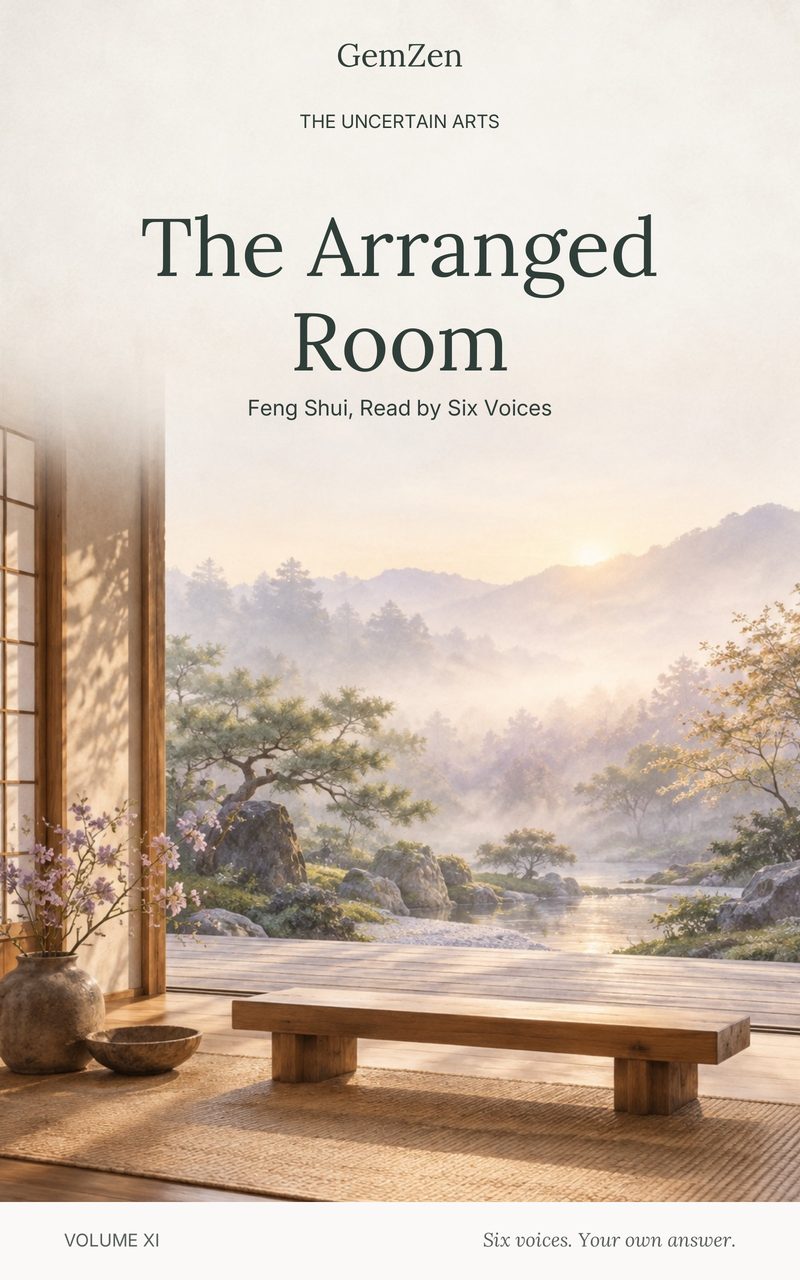
Jacket of The Arranged Room, volume 11 of The Council of Six

Volume 11 of 23

The Arranged Room

Feng Shui, Read by Six Voices

Every one of the 19 areas in this book is read six times, by six voices who do not agree, and the disagreement is more useful than any single reading.

Evidence
Part evidence, part tradition
Attested
c.300 CE — the Zangshu; siting practice attested earlier
Contents
19 areas, read six times each
Extent
77 pages, 6 x 9 inches
Planned editions
Paperback and ebook editions are planned. No ISBNs have been issued; audiobook recordings are not available.
ISBN
Not yet issued

$8.99

Paperback is planned. The displayed price and delivery ladder are unverified proposals; orders are not open — see the ladder.

1

Or take all 23 volumes at a proposed set price; audiobook recordings are not available.

What this book is

Feng shui without the mysticism markup — and without dismissing it either.

The core principles, the nine areas of the bagua map, and the five elements with the cycles that connect them. For each: what the tradition says, what it looks like in a real home, and — separately and clearly labeled — what environmental psychology has actually demonstrated about light, clutter, sightlines, and the position of a chair relative to a door.

Six voices then read each area. The Strategist wants one change you will actually make this weekend. The Skeptic separates the parts with measurable effects from the parts that are tradition and no data. The Mystic reads the room as the tradition intended.

Where this comes from

Earliest surviving evidence

A Chinese hillside grave site at dusk, set in a curve of hills above a stream.

The Zangshu, the Book of Burial, attributed to Guo Pu

China, Eastern Jin · Classical Chinese · 300 CE

A short treatise on siting graves so that qi accumulates rather than disperses, attributed to Guo Pu (276-324 CE). It gives the discipline its name — wind and water — and its founding idea: that the shape of land and the flow of air and water around a site determine what happens to what is placed there. It is about tombs. Houses come later.

How it reached you

  1. 900 CE

    The Form School, Jiangxi

    Reads landscape shape directly — dragon veins, protective hills, water courses. This is the older and more empirical branch.

  2. 1100

    The Compass School, Fujian

    Uses the luopan compass and the eight trigrams to assign directional qualities. The flying stars and the eight-mansion systems come from here.

  3. 1966

    The Cultural Revolution

    Feng shui is suppressed on the mainland as feudal superstition. Continuity passes through Hong Kong, Taiwan and the diaspora.

  4. 1983

    Lin Yun, in English through Sarah Rossbach

    Western feng shui — the bagua map laid over a floor plan and oriented to the front door rather than to the compass — reaches print in Rossbach's Feng Shui: The Chinese Art of Placement, written from Lin Yun's teaching. Her Interior Design with Feng Shui follows in 1986 and is the book that put mirrors and wind chimes into American houses. It is explicitly a new synthesis, and its founder said so.

The version you have actually met

1983 · Lin Yun's Black Hat school, in English through Sarah Rossbach

The version in Western bookshops, with a wealth corner and a relationship corner located relative to the entrance, is a 1980s American adaptation. The Chinese schools use a compass and would not recognise it.

What you have probably been told

The wealth corner is ancient Chinese practice.

Orienting the bagua to the front door instead of to magnetic south is a Black Hat innovation from the 1980s. Classical practice requires a compass reading and a birth date.

Bruun, An Introduction to Feng Shui, 2008

Feng shui is about decorating your home.

For most of its history it was primarily about where to bury the dead, and secondarily about where to site a settlement. Interior arrangement is a late and minor application.

Guo Pu, Zangshu

What survives the correction

Almost every classical prescription reduces to sightlines, air movement, daylight, thermal comfort and whether you can see the door from where you sleep — which is to say, to environmental psychology arrived at by four centuries of watching. The reasoning is wrong and the observations are frequently right.

What can be established

Part evidence, part tradition

What survives

A surprising amount. Sightlines, daylight, air movement, thermal comfort, a protected outlook, and being able to see the door from where you sit are all supported by environmental psychology, and classical feng shui prescribes most of them. Four centuries of watching where people slept badly produced real observations.

What does not

Directional qi, the compass calculations, the flying stars, and above all the Western wealth corner — which is 1980s American in origin and located relative to your front door rather than to anything physical.

What has been tested

Ulrich (1984)

Science 224, 420-421 · 46 patients, 23 matched pairs

Tested Whether a hospital window view of trees rather than a brick wall affects surgical recovery

Found Patients with the tree view had shorter stays, fewer negative nursing notes and took fewer strong analgesics

Since The broad finding — that natural views aid recovery — has held up across a large subsequent literature

Kaplan and Kaplan (1989)

The Experience of Nature

Tested Which spatial configurations people prefer and find restorative

Found Consistent preference for prospect with refuge — an open outlook from a protected position — which is close to the classical armchair formation feng shui prescribes

Since Yes, across environmental psychology

Chan and Lee (2008)

Building and Environment

Tested Whether feng shui prescriptions correspond to measurable building-performance factors

Found Substantial overlap with daylight, ventilation and thermal-comfort criteria

Since Consistent with the wider environmental-design literature

What would change this rating

A trial in which rooms arranged by compass-school calculation outperform rooms arranged by daylight and sightline criteria alone. The prediction is testable and the two schools disagree with each other, which makes it more so.

A rating that no possible finding could alter is an opinion. Every volume names the result that would move it.

What it cannot establish

Some of this is well evidenced and some is tradition. Each chapter says which. The attestation date given for this system (c.300 CE) rests on the Zangshu; siting practice attested earlier; it dates the system, not any claim the system makes.

Every volume states its own limits. See all 23.

5 readings from this volume, free

Zhen

Vol. 11 · The Arranged Room

The Astrologer

The East direction corresponds to the rising sun—the place of emergence and potential. In your birth chart, look to Jupiter (expansion) and your 4th house (family/roots) for resonances. Spring equinox is an auspicious time to activate this area.

The Body Reader

When the Family area is blocked, you may notice tension in your jaw (inherited patterns), lower back (foundational support), or liver area (Wood element). Your body may unconsciously contract when family topics arise. Notice where you hold ancestral stories in your tissues.

The Herbalist

The Wood element of Zhen calls for bitter greens that support the liver—dandelion, arugula, artichoke. Morning is the time of Wood energy; begin your day with warm lemon water to honor this area. Consider placing a small potted herb in this section of your home.

The Strategist

Your Family area is where new projects either launch or languish. If you're struggling to start something, physically activate this corner—add a plant, move stagnant objects, or spend time there. The space mirrors your capacity for new beginnings.

The Skeptic

Environmental psychology confirms that family photos and personal mementos do affect mood and sense of belonging. Whether you attribute this to "Qi" or to simple association doesn't change the effect. Clean, meaningful spaces support psychological well-being.

The Mystic

Your ancestors are not just in the past—they're in your cells, your gestures, your unexplained knowings. This area is a portal for ancestral healing. What gifts did they pass down? What burdens can you consciously release?

Xun

Vol. 11 · The Arranged Room

The Astrologer

Jupiter rules expansion and abundance; Venus rules value and worth. When these planets transit your 2nd house (possessions) or 8th house (shared resources), activating this Bagua area amplifies their effects. The waxing moon phase supports abundance work.

The Body Reader

Wealth blocks often manifest as tight shoulders (carrying burdens), clenched hands (grasping or fear of loss), or shallow breathing (scarcity panic). Notice your body's response when you think about money. Where do you contract? That's where you're holding your abundance story.

The Herbalist

Basil is traditionally associated with prosperity in many cultures. Consider growing it in your Wealth area. Cinnamon and ginger stimulate circulation and symbolically "warm" stagnant resources. A cup of warming tea while you tend to your finances creates a different relationship with money.

The Strategist

If your Wealth area is cluttered or neglected, you're signaling that abundance isn't a priority. This week: spend 15 minutes organizing this space. Add something that represents prosperity TO YOU—not generic "wealth symbols" but something personally meaningful.

The Skeptic

No spatial arrangement will pay your bills. However, studies show that environments reflecting intentionality and self-worth correlate with higher productivity and better financial decision-making. The practice is psychological, not magical.

The Mystic

True wealth is the deep knowing that life wants you to thrive. This corner isn't about manifesting money—it's about healing the wounds that make you believe you don't deserve to be nourished. What story about worthiness are you ready to release?

Li

Vol. 11 · The Arranged Room

The Astrologer

The South corresponds to the Midheaven in astrology—your public reputation and career calling. Leo and the Sun rule recognition. When the Sun transits your 10th house, activate this area to support professional visibility.

The Body Reader

The Fire element governs the heart. Fame blocks may show as guarded posture, protected heart space, or a voice that doesn't carry. Notice if you literally shrink when you should be visible. Your body knows when you're hiding your light.

The Herbalist

Heart-supporting herbs like hawthorn and hibiscus align with the Fire element. Rose opens the heart to receiving recognition. Consider lighting a candle during meals to honor your flame. Red foods—beets, cherries, tomatoes—nourish Fire energy.

The Strategist

Your Fame area is about alignment between who you are and how you're perceived. If this area is dark or neglected, ask: where am I hiding? What recognition am I avoiding? Sometimes we fear visibility as much as we crave it.

The Skeptic

Good lighting genuinely affects mood, energy, and perceived competence. Well-lit spaces make people feel more confident and capable. You don't need metaphysics to explain why a bright room feels better than a dim one.

The Mystic

The fire doesn't ask permission to shine. Neither should you. This area invites you to consider: what do you want to be remembered for? Not for ego, but for legacy. What light are you here to carry?

Kun

Vol. 11 · The Arranged Room

The Astrologer

Venus rules love and the 7th house governs partnership. When Venus transits your 7th house or makes aspects to your natal Venus, work with this area. New and full moons in Libra are potent for relationship intentions.

The Body Reader

The Earth element holds and nurtures. Relationship blocks often show in the hips (where we hold intimacy patterns), pelvis, and heart. Notice if your body tenses when you consider receiving care. Love requires a soft body.

The Herbalist

Rose is the ultimate love herb—use rose tea, rose water, or rose petals. Damiana and cacao gently open the heart. Earth element foods—root vegetables, squash, naturally sweet foods—nourish our capacity for nurturing relationships.

The Strategist

If you want partnership, does your space reflect it? A single pillow, one nightstand, photos of yourself alone—these send signals. Create space for another, even symbolically. Clear out the ex's energy. Make room.

The Skeptic

Surrounding yourself with relationship-focused imagery keeps partnership top of mind, which may influence behavior and choices. This is confirmation bias and priming, not magic. But priming does work—advertisers count on it.

The Mystic

All relationship is first relationship with self. This area is as much about self-marriage—honoring your own worthiness—as it is about attracting another. How do you treat yourself when no one is watching?

Dui

Vol. 11 · The Arranged Room

The Astrologer

The 5th house rules creativity, pleasure, and children. Leo energy governs creative expression. When the Sun transits your 5th house or Venus makes favorable aspects, activate this Bagua area for creative flow.

The Body Reader

Creativity lives in the lower belly (sacral energy) and the throat (expression). Blocks may show as tight hips (where we store unexpressed play) or a tight throat (where we swallow creative impulses). Let your body move without purpose. That's play.

The Herbalist

Metal element herbs tend to be aromatic and clearing—peppermint, eucalyptus, thyme. Clear, fresh scents in this area support mental clarity and creative focus. White or light-colored foods (cauliflower, white beans, coconut) nourish Metal energy.

The Strategist

If you can't create, look at this area. Is it dusty, neglected, full of "responsible" objects? Add something playful. Give yourself permission to make bad art. Creativity needs low stakes to begin.

The Skeptic

Environmental psychology shows that dedicated creative spaces improve creative output. If you never see your art supplies, you won't use them. Visibility and accessibility matter for habit formation.

The Mystic

Every creative act is a small birth—bringing something from nothing into form. This area asks: what wants to be born through you? What have you been refusing to create because you don't think you're "allowed"?

All free readings across the series

One book page annotated in the margins by six visibly different hands.
One page, read six times. That is the whole method.

Complete contents

19 areas

The Council on Feng Shui

  1. What Feng Shui Is

The Core Principles

  1. The Command Position
  2. The Flow of Qi
  3. Yin and Yang Balance
  4. Clutter as Stuck Energy

The Bagua Map

  1. Zhen
  2. Xun
  3. Li
  4. Kun
  5. Dui
  6. Qian
  7. Kan
  8. Gen
  9. Tai Qi

The Five Elements

  1. Wood
  2. Fire
  3. Earth
  4. Metal
  5. Water

Sources

#FileWhat was drawn from it
1oracles/feng-shui/feng-shui.yamlthe whole document
2oracles/feng-shui/feng-shui.yamlcore_principles
3oracles/feng-shui/feng-shui.yamlbagua_map.areas
4oracles/feng-shui/feng-shui.yamlfive_elements

The knowledge base this volume is extracted from, file by file.

Questions

What is in The Arranged Room?

All 19 areas of the system, in 4 parts. Each one is read by the six voices of the Council in turn, then followed by space to answer for yourself.

How well evidenced is this system?

Some of this is well evidenced and some is tradition. Each chapter says which. On the series' six-point ledger it is rated part evidence, part tradition.

How old is it?

The system is first attested c.300 CE, on the basis of the Zangshu; siting practice attested earlier. That dates the system, not any claim the system makes.

What can The Arranged Room not tell me?

Some of this is well evidenced and some is tradition. Each chapter says which. The attestation date given for this system (c.300 CE) rests on the Zangshu; siting practice attested earlier; it dates the system, not any claim the system makes.

Who are the six voices?

An Astrologer who reads timing, a Body Reader who asks where a thing lands in you, a Herbalist who asks what it costs, a Strategist who wants your next concrete step, a Skeptic who pushes back on all of it, and a Mystic who goes further than the other five. They appear in every chapter, in that order, and they disagree.

How long is it?

77 printed pages at 6 x 9 inches — roughly 1 hours and 42 minutes of reading, though most people use it a chapter at a time rather than front to back.

Can I read some of it first?

Yes. 5 complete readings from this volume are published free below, and every chapter title is listed on this page.