
The Council of Six
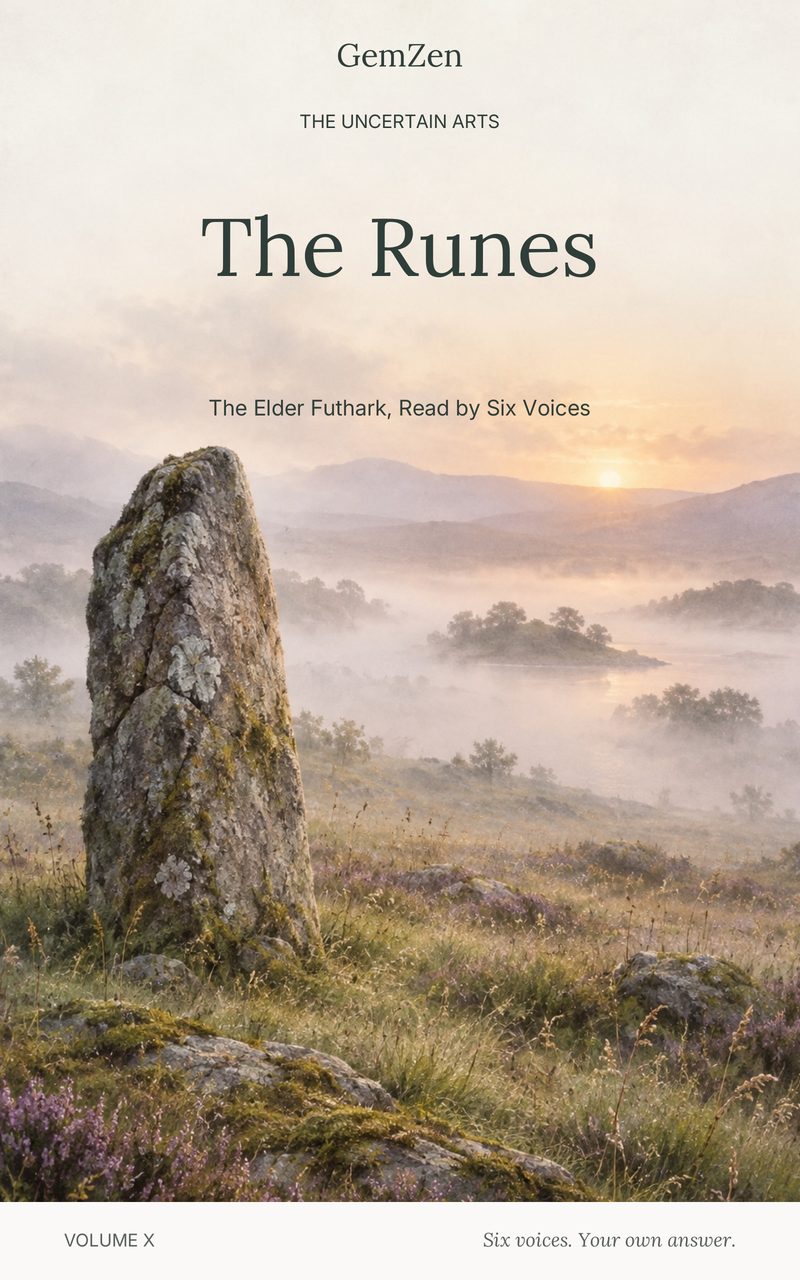
Jacket of The Runes, volume 10 of The Council of Six

Volume 10 of 23

The Runes

The Elder Futhark, Read by Six Voices

Every one of the 24 runes in this book is read six times, by six voices who do not agree, and the disagreement is more useful than any single reading.

Evidence
Traditional
Attested
c.150 CE — the earliest Elder Futhark inscriptions
Contents
24 runes, read six times each
Extent
106 pages, 6 x 9 inches
Planned editions
Paperback and ebook editions are planned. No ISBNs have been issued; audiobook recordings are not available.
ISBN
Not yet issued

$8.99

Paperback is planned. The displayed price and delivery ladder are unverified proposals; orders are not open — see the ladder.

1

Or take all 23 volumes at a proposed set price; audiobook recordings are not available.

What this book is

Twenty-four runes of the Elder Futhark — the oldest writing system in Northern Europe, and an oracle that has outlived every empire that used it.

Each rune gets its name, its sound, its upright and reversed meanings, the mythology it carries, and its plain advice — then six voices read it six different ways. The Skeptic reminds you that the historical record is thinner than most rune books admit, and says so.

Includes how to cast runes, why nine of them look identical upside down and what to do about it, the three aettir and what each governs, and an honest account of what we actually know about how the runes were used versus what was reconstructed in the twentieth century.

For readers who want the depth without the invented pedigree.

Where this comes from

Earliest surviving evidence

A Danish bog at first light with a plank causeway and iron fittings half-sunk at the water's edge.

The Vimose comb

Vimose bog, Funen, Denmark · Proto-Germanic, in Elder Futhark · 150 CE

A bone comb with a single word cut into it: harja. Either a personal name or the word for warrior, or possibly the word for comb. It is dated to around 160 CE and is the oldest inscription that is beyond dispute runic. The cutting is confident and mature, which is why philologists assume at least a century of prior use that has not survived.

How it reached you

  1. 98 CE

    Tacitus, Germania 10

    Describes Germanic divination by cutting marks on strips of fruitwood, scattering them on white cloth and taking three. This is the single classical witness for rune divination, it predates any surviving runic inscription, and Tacitus does not say the marks were runes.

  2. 150 CE

    Germanic-speaking northern Europe

    The Elder Futhark, twenty-four characters, in use for roughly six hundred years across a very wide area. Surviving inscriptions are overwhelmingly ownership marks, maker's marks, memorials and names.

  3. 800 CE

    The Younger Futhark

    The alphabet is reduced from twenty-four characters to sixteen for Old Norse. The Viking-age runes most people picture are this set, not the one sold in rune bags.

  4. 1982

    Ralph Blum, The Book of Runes

    The commercial rune-divination system is created. Blum invented a blank rune, assigned an order and meanings substantially of his own devising, and sold several million copies. Almost every rune set sold since follows him.

The version you have actually met

1982 · Ralph Blum

Modern rune divination is a 1982 American invention using a genuine ancient alphabet. The letters are real and old; the divinatory meanings, the order and the blank rune are not.

What you have probably been told

The runes were an oracle used by the Vikings.

They were an alphabet. Roughly six thousand runic inscriptions survive and they are names, memorials, ownership marks, prayers and graffiti. No surviving inscription is a divinatory reading.

Page, An Introduction to English Runes, 1999

The blank rune is Odin's rune, the rune of the unknowable.

It was introduced by Ralph Blum in 1982. There are twenty-four Elder Futhark characters and none of them is blank.

Blum, The Book of Runes, 1982

What survives the correction

The rune poems are genuinely old and genuinely strange, and their images — hail, ice, the wild ox, the yew — are the vocabulary of people who lived closer to weather and consequence than we do. Read as poetry rather than as an oracle, they still land.

What can be established

Traditional

What survives

Twenty-four images drawn from a genuinely harsh material world — hail, ice, the aurochs, the yew, the grave — form a vocabulary for difficulty that modern language has largely lost. Read as poetry the rune poems still work, and the Old English and Old Norse rune poems are real medieval texts.

What does not

That drawing a rune from a bag yields information about a situation. Untested, and complicated by the fact that the divinatory meanings being drawn on were published in 1982. There is no ancient system to test.

What has been tested

No study of this system has been published — not a weak one, not a disputed one, none at all. That is a statement about the literature and not about the practice, and this page would say so just as plainly if the reverse were true.

What would change this rating

Any controlled test at all. There has not been one, which is why this volume is rated traditional rather than disconfirmed — an important distinction this series insists on.

A rating that no possible finding could alter is an opinion. Every volume names the result that would move it.

What it cannot establish

Centuries of observation, no demonstrated mechanism. Read as a mirror. The attestation date given for this system (c.150 CE) rests on the earliest Elder Futhark inscriptions; it dates the system, not any claim the system makes.

Every volume states its own limits. See all 23.

6 readings from this volume, free

Fehu

Vol. 10 · The Runes

The Astrologer

Fehu carries the energy of Jupiter and Venus combined—expansion meeting value. If you're experiencing favorable transits to your second house or benefic aspects, this rune might be confirming that the timing for material endeavors is aligned. Consider what seeds you've planted that could now bear fruit.

The Body Reader

Wealth begins in the body as a sense of enoughness. Notice where you hold scarcity— tight jaw, clenched hands, shallow breathing. Fehu asks: can your body relax into receiving? The physical tension of "not enough" blocks the very flow you seek.

The Herbalist

Nourishment is the first wealth. When Fehu appears, consider whether you're feeding yourself well—not just food, but sleep, warmth, basic care. Like cattle need good pasture, your prosperity grows from tended foundations. Nettle and oat straw build reserves gently.

The Strategist

Fehu suggests resources are available or coming. The practical question: how will you steward them? Consider creating a simple tracking system for what flows in and out. Wealth that isn't managed dissipates. What's one concrete step toward building sustainable abundance?

The Skeptic

Prosperity runes feel good but warrant caution. If you're hoping Fehu means windfall, examine: are you building real value, or waiting for luck? Material gain that isn't earned tends not to last. What skill or service could you develop that creates genuine worth?

The Mystic

The first rune teaches that spirit and matter aren't separate. Freyr's cattle represent sacred abundance—wealth that circulates, feeds the community, generates life. What you're really being asked is: can you receive without hoarding? True wealth flows through you, not to you.

Raidho

Vol. 10 · The Runes

The Astrologer

Raidho resonates with the ninth house—long journeys, philosophy, expansion of horizons. If Jupiter or Sagittarian energy is active in your chart, this rune confirms movement is favored. Consider both literal travel and the journey of understanding. Where could a change of perspective take you?

The Body Reader

The body knows rhythm before the mind understands timing. Notice your natural cycles—when you're energized, when you need rest. Raidho asks: are you moving with your body's wisdom or against it? The right journey at the wrong time exhausts; the same journey at the right time energizes.

The Herbalist

Travel depletes certain reserves. If a journey is coming—physical or otherwise— consider building resilience now. Adaptogens like schisandra support transitions. Ginger settles the stomach of the traveler, literal and metaphoric. What would help you move through change with more ease?

The Strategist

Raidho suggests forward movement is indicated. The strategic question: what's the most efficient path? Not every journey requires the scenic route. Map your destination, identify waypoints, and consider what you can leave behind to travel lighter. What's one step you could take this week?

The Skeptic

Movement can be avoidance in disguise. If Raidho appeared and you're itching to change something, ask: are you journeying toward something, or running from something? Sometimes the most courageous path is staying and facing what's here. Why do you want to move?

The Mystic

Thor's chariot crosses the sky in perfect order. Raidho teaches that the journey itself is sacred—not just the destination. You are always mid-journey, always arriving, always departing. What if the path you're on is exactly right, even when it doesn't feel like it?

Hagalaz

Vol. 10 · The Runes

The Astrologer

Hagalaz carries the energy of Uranus and Pluto—sudden disruption that transforms. If you're experiencing hard aspects from outer planets, this rune acknowledges the upheaval but also its purpose. The storm isn't punishment; it's clearing. What structures in your life might actually need to fall?

The Body Reader

Disruption registers in the body as shock—breath stops, muscles freeze, heart pounds. If unexpected change is happening, your nervous system needs support. Ground first: feet on floor, slow breath, orient to safety. Then, from that centered place, respond. The storm will pass; your body can weather it.

The Herbalist

Hail destroys the crop but melts into water that nourishes the soil. In crisis, consider nervine herbs—skullcap, valerian, linden—to support your nervous system. Also remember: some plants only germinate after fire or flood. What in you might need disruption to awaken?

The Strategist

Hagalaz suggests forces beyond your control are operating. The strategic response: don't fight the storm, shelter through it. What can you protect? What can you release? Sometimes the best strategy is damage control and waiting for calm. What would strategic surrender look like here?

The Skeptic

Framing destruction as "necessary" can justify passivity. If Hagalaz appeared, examine: is this truly uncontrollable, or are there actions you could take? Not everything that feels like fate is fate. What agency do you actually have in your current situation?

The Mystic

The mother of all runes teaches that creation and destruction are one breath. What falls is fertilizer for what rises. Hagalaz asks: can you trust the destruction? Not understand it, not like it—trust it. What if this storm is exactly what your soul requested, even if your personality didn't?

Eihwaz

Vol. 10 · The Runes

The Astrologer

Eihwaz resonates with Pluto—transformation through death and rebirth. If Pluto is transiting significant points, this rune acknowledges you're in a fundamental change process. The yew outlasts centuries; you too can endure this transformation. What's dying in you makes room for what's being born.

The Body Reader

The spine is your inner yew tree—axis between worlds, structural integrity. Notice your posture: are you standing firm or collapsing? Eihwaz asks about your backbone, literal and metaphoric. Sometimes transformation requires you to be utterly still while everything changes around you.

The Herbalist

The yew is deadly poisonous and medicinally powerful—the same substance that kills can heal in proper dosage. Eihwaz suggests that what feels threatening might also be transformative. Consider: what "poison" in your life might be medicine at a different dose? What needs careful handling, not avoidance?

The Strategist

Eihwaz suggests a threshold that can't be avoided, only crossed. The strategic response: prepare for transition, don't fight it. What skills, resources, or support will you need on the other side? Transformation doesn't have to be chaotic. What can you put in place now to make the crossing smoother?

The Skeptic

"Death and rebirth" language can dramatize ordinary change. If Eihwaz appeared, ask: is this truly a life-altering transformation, or are you adding mythic weight to a normal transition? Sometimes things just change. They don't all require the underworld journey.

The Mystic

The yew stands in graveyards, roots drinking from the dead, branches reaching toward the living. Eihwaz is the axis between worlds, the shamanic tree. What part of you knows how to travel between life and death, past and future, above and below? That part is needed now.

Tiwaz

Vol. 10 · The Runes

The Astrologer

Tiwaz resonates with Mars in its noblest form—not aggression but courage, not force but justice. If Mars is active in your chart, this rune asks how you're using that energy. Are you fighting for something worthy? Some battles honor you; others diminish you. Choose carefully.

The Body Reader

Tyr gave his sword hand knowingly. Sacrifice lives in the body as voluntary discomfort—the willingness to bear what's difficult for what matters. Notice: can you stay with discomfort when it serves something larger? That capacity is Tiwaz strength, different from just enduring.

The Herbalist

Warrior herbs—ashwagandha, eleuthero, rhodiola—support sustained effort for worthy causes. But Tiwaz also asks about recovery: the warrior must rest. If you're sacrificing endlessly, examine: is this noble service or self-destruction in costume? Even Tyr had only one hand to give.

The Strategist

Tiwaz suggests that success requires sacrifice—not everything can be had. The strategic question: what are you willing to give up to get what you want? What's the exchange rate? Clear-eyed sacrifice is strategic; martyrdom usually isn't. What's actually worth your hand?

The Skeptic

Sacrifice can become identity. If Tiwaz appeared, examine: is this sacrifice truly necessary, or have you become attached to being one who sacrifices? Sometimes what looks like honor is just habit. What would remain of your self-image if you stopped giving yourself away?

The Mystic

Tyr knew the wolf would take his hand. He put it in the mouth anyway. Tiwaz asks: what would you willingly lose for what matters? Not carelessly, not as victim—as choice. True sacrifice is conscious exchange with the sacred. What might you offer, knowing the cost, for what you believe?

Laguz

Vol. 10 · The Runes

The Astrologer

Laguz carries the Moon and Neptune—emotional depth, intuitive knowing, the unconscious realm. If water signs or these planets are active, this rune confirms the importance of honoring non-rational wisdom. Your dreams, hunches, and feelings contain information. Are you listening?

The Body Reader

Emotions move through the body like water—when flowing, they bring life; when blocked, they stagnate. Notice where feelings pool or dam in you. Laguz asks: can you let your emotional body flow? Tears, laughter, trembling—these are water finding its way through.

The Herbalist

Water herbs—chamomile, lemon balm, mimosa—help emotions flow without flooding. If Laguz appeared and you're overwhelmed, consider gentle nervines. If you're dried out emotionally, hydration—literal water and fluid-rich foods—might help as much as any herb. Life is mostly water.

The Strategist

Laguz suggests intuition has data your rational mind doesn't. The strategic approach: don't dismiss gut feelings, but don't abandon analysis either. What does your intuition say about your current situation? Now, what evidence supports or contradicts that sense? Use both streams.

The Skeptic

Intuition can be right and can be projection. If Laguz appeared, examine: is this genuine inner knowing, or emotional reaction disguised as wisdom? Not every feeling is a message. Sometimes fear is just fear, not guidance. How could you test your intuition rather than just trusting it?

The Mystic

The well of memory, the sea of the unconscious, the waters of the womb—Laguz is the source of life itself. To work with water is to work with what you can't control, only navigate. What would it mean to float rather than swim, to be carried rather than to direct?

All free readings across the series

One book page annotated in the margins by six visibly different hands.
One page, read six times. That is the whole method.

Complete contents

24 runes

Freya’s Aett

  1. Fehu
  2. Uruz
  3. Thurisaz
  4. Ansuz
  5. Raidho
  6. Kenaz
  7. Gebo
  8. Wunjo

Heimdall’s Aett

  1. Hagalaz
  2. Nauthiz
  3. Isa
  4. Jera
  5. Eihwaz
  6. Perthro
  7. Algiz
  8. Sowilo

Tyr’s Aett

  1. Tiwaz
  2. Berkano
  3. Ehwaz
  4. Mannaz
  5. Laguz
  6. Ingwaz
  7. Dagaz
  8. Othala

Sources

#FileWhat was drawn from it
1oracles/runes/elder-futhark.yamlrunes

The knowledge base this volume is extracted from, file by file.

Questions

What is in The Runes?

All 24 runes of the system, in 3 parts. Each one is read by the six voices of the Council in turn, then followed by space to answer for yourself.

How well evidenced is this system?

Centuries of observation, no demonstrated mechanism. Read as a mirror. On the series' six-point ledger it is rated traditional.

How old is it?

The system is first attested c.150 CE, on the basis of the earliest Elder Futhark inscriptions. That dates the system, not any claim the system makes.

What can The Runes not tell me?

Centuries of observation, no demonstrated mechanism. Read as a mirror. The attestation date given for this system (c.150 CE) rests on the earliest Elder Futhark inscriptions; it dates the system, not any claim the system makes.

Who are the six voices?

An Astrologer who reads timing, a Body Reader who asks where a thing lands in you, a Herbalist who asks what it costs, a Strategist who wants your next concrete step, a Skeptic who pushes back on all of it, and a Mystic who goes further than the other five. They appear in every chapter, in that order, and they disagree.

How long is it?

106 printed pages at 6 x 9 inches — roughly 2 hours and 20 minutes of reading, though most people use it a chapter at a time rather than front to back.

Can I read some of it first?

Yes. 6 complete readings from this volume are published free below, and every chapter title is listed on this page.