
The Council of Six
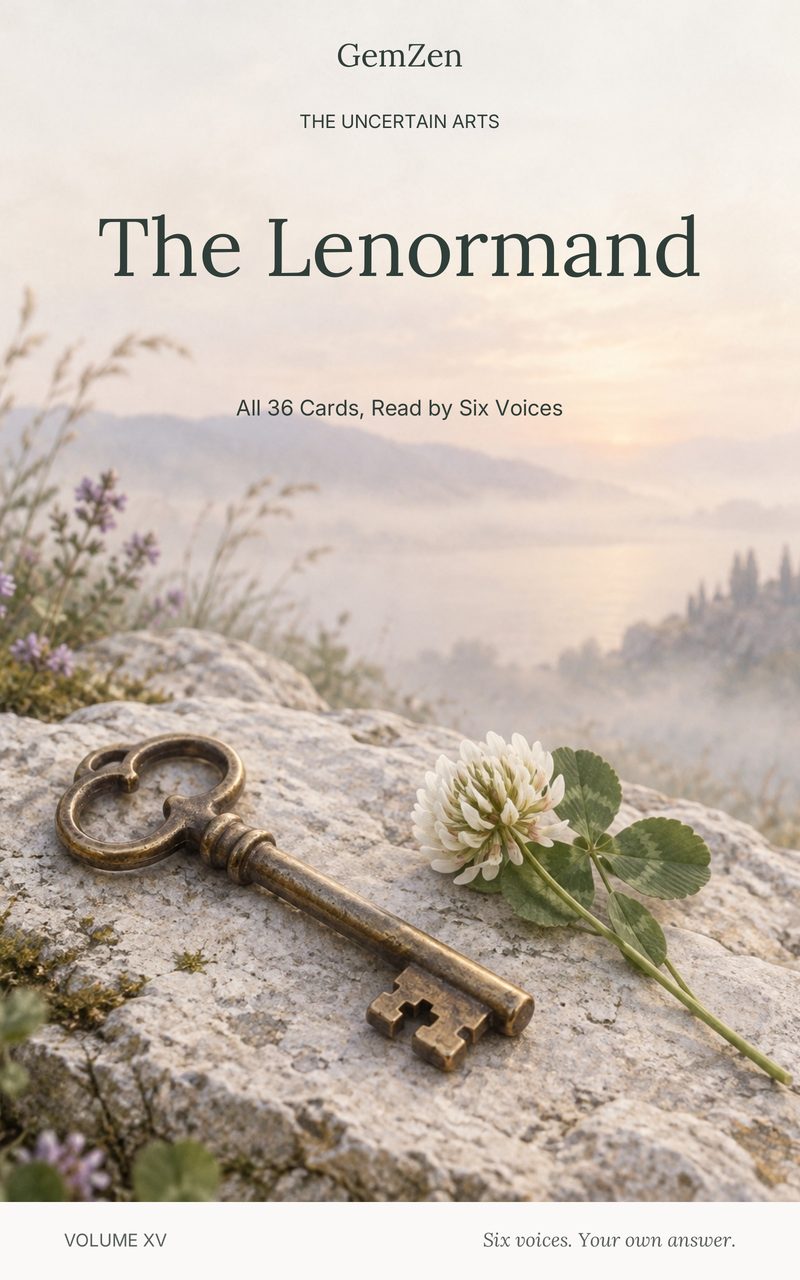
Jacket of The Lenormand, volume 15 of The Council of Six

Volume 15 of 23

The Lenormand

All 36 Cards, Read by Six Voices

Every one of the 36 cards in this book is read six times, by six voices who do not agree, and the disagreement is more useful than any single reading.

Evidence
Traditional
Attested
1799 — the Game of Hope; the Lenormand deck proper from 1846
Contents
36 cards, read six times each
Extent
107 pages, 6 x 9 inches
Planned editions
Paperback and ebook editions are planned. No ISBNs have been issued; audiobook recordings are not available.
ISBN
Not yet issued

$8.99

Paperback is planned. The displayed price and delivery ladder are unverified proposals; orders are not open — see the ladder.

1

Or take all 23 volumes at a proposed set price; audiobook recordings are not available.

What this book is

Lenormand is tarot's blunt cousin. Where tarot muses, Lenormand answers — short, literal, and slightly rude about it.

This is a complete guide to all thirty-six cards, each read by six voices. For every card: core meaning, keywords, timing, plain advice, and six perspectives that argue about what it is really telling you.

Includes how Lenormand differs from tarot in practice, how to read cards in pairs (where the system actually lives), the Grand Tableau explained without mysticism, and why the deck's literalism is a feature rather than a limitation.

A working reference for readers who want an oracle that gives them a straight answer.

Where this comes from

Earliest surviving evidence

A Nuremberg game maker's bench in 1799 with printed card sheets, a cutting knife and a wooden game box.

Das Spiel der Hofnung (The Game of Hope)

Nuremberg · German · 1799

A boxed parlour game published by Johann Kaspar Hechtel in 1799: thirty-six numbered cards, each carrying a small symbol and a playing-card inset, laid out in a grid as a race track. Players moved counters along it by dice. Those thirty-six symbols — the Rider, the Clover, the Ship, the Coffin — are exactly the modern Lenormand deck.

How it reached you

  1. 1843

    The death of Marie Anne Le Normand

    Le Normand was a genuinely famous Parisian cartomancer who read for Josephine de Beauharnais and was said to have read for Robespierre. She used large, complex decks of her own. She had nothing to do with Hechtel's game.

  2. 1846

    German publishers

    Hechtel's game is reissued as a fortune-telling deck bearing Le Normand's name, three years after her death, with the race-track rules dropped and divinatory meanings added. The name sold; the attribution was posthumous and commercial.

  3. 1900

    German and Russian household practice

    The Petit Lenormand becomes a domestic reading tradition, largely oral, with a compact grammar: cards are read in pairs and in a nine-by-four Grand Tableau rather than singly.

  4. 2004

    The English-language revival

    Anglophone readers rediscover the deck, largely through the internet, and frequently import tarot habits it was never built for.

The version you have actually met

1846 · An anonymous German publisher, capitalising on a dead woman's fame

The deck has been sold under a false attribution for its entire divinatory career, and the attribution is now so settled that the true inventor's name appears on almost nothing.

What you have probably been told

Marie Anne Lenormand created this deck.

She died in 1843. The cards were published as a parlour game in 1799 by Johann Kaspar Hechtel and were attached to her name around 1846 to sell them.

Hechtel, Das Spiel der Hofnung, Nuremberg 1799

Lenormand is a simplified tarot.

It is not related to tarot and does not work like it. Lenormand cards have narrow literal meanings and are read in combination, closer to a sentence than to a symbol. Reading one card deeply, tarot-style, is the standard beginner's error.

Standard Lenormand practice

What survives the correction

Thirty-six blunt, concrete, unmystical nouns — a ring, a letter, a fox, a coffin — are unusually hard to hide behind. The deck's flatness is the point, and its history is the best argument in the series that a practice can be built on a false story and still be a decent instrument.

What can be established

Traditional

What survives

Thirty-six concrete nouns read in combination force specificity in a way open-ended symbols do not. Where a tarot card lets a querent drift toward a comfortable abstraction, Fox plus Letter is hard to soften. The deck's bluntness is a genuine design advantage.

What does not

That the cards correspond to the situation. Never tested directly; there is no reason to expect it to differ from the tarot result, and the same Barnum and cold-reading findings apply.

What has been tested

No study of this system has been published — not a weak one, not a disputed one, none at all. That is a statement about the literature and not about the practice, and this page would say so just as plainly if the reverse were true.

What would change this rating

The same forced-choice design that would settle tarot. Lenormand would be an easier test, because its meanings are narrow enough to score.

A rating that no possible finding could alter is an opinion. Every volume names the result that would move it.

What it cannot establish

Centuries of observation, no demonstrated mechanism. Read as a mirror. The attestation date given for this system (1799) rests on the Game of Hope; the Lenormand deck proper from 1846; it dates the system, not any claim the system makes.

Every volume states its own limits. See all 23.

6 readings from this volume, free

Rider

Vol. 15 · The Lenormand

The Astrologer

The Rider carries Mercury energy—swift communication and movement. If this card appears during a Mercury transit or when Mercury aspects your chart, news might arrive even faster than expected. Consider whether you're positioned to receive what's coming.

The Body Reader

Notice where your body holds anticipation. The Rider often brings a quickening sensation—a flutter in the chest, feet wanting to move. This restless energy wants expression. A brisk walk might help you channel the waiting into something physical.

The Herbalist

When news approaches, anxiety can build. Gentle nervines like lemon balm or chamomile could help settle anticipatory energy. Keep yourself nourished and rested so you're prepared to act when the moment arrives.

The Strategist

The Rider suggests something is en route—prepare your response now. What would you do if good news arrived? What if challenging news came? Having contingency plans means you can act swiftly rather than react impulsively.

The Skeptic

Not every message is urgent, and not every visitor brings transformation. Before treating incoming news as momentous, consider: is this genuinely significant, or am I projecting importance onto ordinary communication?

The Mystic

The Rider asks you to become receptive to messages from life itself. Sometimes news comes through synchronicities, dreams, or chance encounters. What might be trying to reach you that you haven't been open to hearing?


Snake

Vol. 15 · The Lenormand

The Astrologer

The Snake carries Plutonian undertones—transformation through descent, wisdom earned in darkness. If Pluto or Scorpio factors are active in your chart, complications might be initiating deeper change. Consider what the difficulty is teaching you.

The Body Reader

The Snake moves in curves, not straight lines. Notice where your body holds tension when facing complications—a clenched jaw, tight shoulders. Sometimes the most direct path isn't possible, and your body might know the winding route even when your mind resists it.

The Herbalist

Snake medicine traditionally relates to healing through venom— transformation through difficulty. Bitter herbs have their place in wellness. Consider what challenging experience might actually be medicine, even if it doesn't taste sweet.

The Strategist

Complications require flexible navigation rather than forceful directness. When the straight path is blocked, a strategic detour might reach your goal more effectively. Assess the obstacle and find the path around it.

The Skeptic

Not every complication contains hidden wisdom—sometimes problems are just problems. Before searching for deep meaning in difficulties, consider whether practical problem-solving might be more useful than philosophical interpretation.

The Mystic

The Snake sheds its skin to grow—transformation requires releasing the old self. What complication in your life might be initiating necessary shedding? What would you become if you emerged from this difficulty transformed?

Child

Vol. 15 · The Lenormand

The Astrologer

The Child resonates with the first house and Aries—new identity, fresh starts, the courage to begin again. If your chart shows new cycle energy, this card affirms approaching situations with curiosity rather than cynicism. What might you discover with fresh eyes?

The Body Reader

Children inhabit their bodies with spontaneous freedom. Notice where you've lost access to playful movement—when did you stop skipping, spinning, moving for the joy of it? Your body remembers how to play, even if your mind has forgotten.

The Herbalist

New beginnings require gentle nurturing, like seedlings need tender care. Don't expect too much of early growth. Small steps, patient tending, and protection from harsh conditions help new ventures establish roots.

The Strategist

Starting small reduces risk and enables learning. Rather than launching major initiatives, consider pilot projects and experiments. Begin modestly, gather information, and scale what works. Small beginnings often lead to sustainable growth.

The Skeptic

Innocent enthusiasm can overlook genuine obstacles. While fresh perspectives have value, ensure that beginner's optimism doesn't blind you to real challenges that experience would help you navigate.

The Mystic

The Child carries the archetype of wonder—the ability to see magic in the ordinary. What have you become too sophisticated to notice? Where has cynicism closed doors that innocence might reopen?

Tower

Vol. 15 · The Lenormand

The Astrologer

The Tower carries Saturn's structural energy—established systems, hierarchies, and the weight of tradition. If institutional matters feature in your chart, this card directs attention there. Consider your relationship with organizations and authority structures.

The Body Reader

Boundaries show in the body as held edges—skin that defines where you end and others begin. Notice your postural boundaries—do you maintain your space or collapse it? Do you wall off or remain porous? Both extremes have consequences.

The Herbalist

Solitude serves as medicine when chosen, but isolation depletes when imposed. If the Tower suggests time alone, consider what nourishment you need for productive solitude. How might you make alone time regenerative rather than lonely?

The Strategist

Institutions have their logic—understanding organizational dynamics helps you navigate them effectively. The Tower suggests working within established structures rather than against them. Sometimes the system serves better as ally than adversary.

The Skeptic

Authority structures aren't inherently benevolent. The Tower can represent legitimate organization or oppressive control. Assess whether the institutions in your life serve you or constrain you unnecessarily.

The Mystic

The Tower stands apart, watching from above. Solitude enables perspective unavailable in the crowd. What might you see from the vantage point of chosen aloneness that immersion in activity obscures?

Ring

Vol. 15 · The Lenormand

The Astrologer

The Ring carries Saturn's binding energy—commitments that structure life through promises kept. When Saturn aspects your partnership sectors, commitments might deepen or demand honoring. Consider what agreements you've made and how well you're keeping them.

The Body Reader

Commitments live in the body as felt bonds—a sense of connection that persists through distance. Notice how your body responds to your commitments—do they feel like anchors or chains? Healthy bonds feel different than trapped ones.

The Herbalist

Long-term commitments require sustained care—just as gardens need ongoing tending, relationships need consistent nourishment. What regular practices maintain the bonds that matter to you?

The Strategist

Commitments create stability but reduce flexibility. The Ring suggests evaluating which agreements serve your current situation and which might need renegotiation. Strategic commitment means binding yourself to what genuinely aligns with your path.

The Skeptic

Commitment to the wrong thing costs more than no commitment at all. Before making binding agreements, assess honestly whether this partnership, contract, or promise truly serves your authentic interests.

The Mystic

The Ring is a circle with no end—commitments that bind through time, promises that transcend convenience. What are you willing to commit to even when it becomes difficult? What bonds are sacred to you?

Sun

Vol. 15 · The Lenormand

The Astrologer

The Sun is the most positive card—solar energy at its fullest. When the Sun in your chart is activated or when you're in a strong solar period, success becomes more accessible. Consider how you might step more fully into your own light.

The Body Reader

Success and happiness live in the body as expansion—chest open, face lifted, energy available. Notice when your body feels this solar quality. These moments of physical brightness guide you toward what genuinely makes you flourish.

The Herbalist

Solar energy needs channels—too much sun can burn. If vitality is high, consider how to sustain and direct it rather than merely expend it. Some herbs support solar energy; others help integrate it without burnout.

The Strategist

When conditions favor success, act. The Sun suggests this is a time to pursue goals, launch initiatives, and step forward confidently. Don't waste favorable conditions through hesitation or excessive caution.

The Skeptic

Positive cards don't guarantee positive outcomes—they indicate favorable conditions that still require appropriate action. Success comes from effort meeting opportunity, not from assuming good fortune is automatic.

The Mystic

The Sun illuminates everything—including what hides in shadow. True clarity shows both light and dark. As you step into success, what becomes visible that obscurity had hidden? What does the light reveal?

All free readings across the series

One book page annotated in the margins by six visibly different hands.
One page, read six times. That is the whole method.

Complete contents

36 cards

  1. Rider
  2. Clover
  3. Ship
  4. House
  5. Tree
  6. Clouds
  7. Snake
  8. Coffin
  9. Bouquet
  10. Scythe
  11. Whip
  12. Birds
  13. Child
  14. Fox
  15. Bear
  16. Stars
  17. Stork
  18. Dog
  19. Tower
  20. Garden
  21. Mountain
  22. Crossroads
  23. Mice
  24. Heart
  25. Ring
  26. Book
  27. Letter
  28. Man
  29. Woman
  30. Lily
  31. Sun
  32. Moon
  33. Key
  34. Fish
  35. Anchor
  36. Cross

Sources

#FileWhat was drawn from it
1oracles/lenormand/lenormand-cards.yamlcards

The knowledge base this volume is extracted from, file by file.

Questions

What is in The Lenormand?

All 36 cards of the system, in 1 part. Each one is read by the six voices of the Council in turn, then followed by space to answer for yourself.

How well evidenced is this system?

Centuries of observation, no demonstrated mechanism. Read as a mirror. On the series' six-point ledger it is rated traditional.

How old is it?

The system is first attested 1799, on the basis of the Game of Hope; the Lenormand deck proper from 1846. That dates the system, not any claim the system makes.

What can The Lenormand not tell me?

Centuries of observation, no demonstrated mechanism. Read as a mirror. The attestation date given for this system (1799) rests on the Game of Hope; the Lenormand deck proper from 1846; it dates the system, not any claim the system makes.

Who are the six voices?

An Astrologer who reads timing, a Body Reader who asks where a thing lands in you, a Herbalist who asks what it costs, a Strategist who wants your next concrete step, a Skeptic who pushes back on all of it, and a Mystic who goes further than the other five. They appear in every chapter, in that order, and they disagree.

How long is it?

107 printed pages at 6 x 9 inches — roughly 2 hours and 22 minutes of reading, though most people use it a chapter at a time rather than front to back.

Can I read some of it first?

Yes. 6 complete readings from this volume are published free below, and every chapter title is listed on this page.